ENGR216 Summer 2017 Q A3[VALID] official answers
Answer ALL parts (a) - (e)
Section A Appendix (as printed with the paper):
Euler's critical load for doubly pinned rods is:
where is the smallest second area moment of the rod cross section, is the elastic or Young's modulus and is the rod length.
The second area moment of a solid circular cross section of radius about any diameter is:
Formulas you may need
- Euler load for a pinned-pinned column () (given in the question; also on the formula sheet)
- Solid circle , (given in the question; also on the formula sheet); hollow circle , (on the formula sheet)
- Strength requirement ; buckling with a safety factor (learn this)
- Axial deformation (learn this)
- Equilibrium of a pin joint, , , with two-force members carrying force along their axes (learn this)
- (a)[3]ThirdProvide a brief general definition of buckling in the context of the three main structural design requirements.
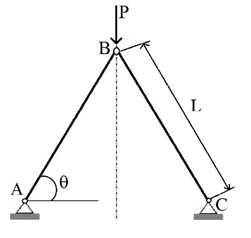
- (b)[3]ThirdConsider the statically determinate symmetric structure depicted in Figure A3, made up of 2 pinned rods subject to a vertical load of acting on the joint B, as indicated in the figure. Both rods have length of and . Their material has Young's modulus , and allowable normal stress of . Assume a buckling safety factor of 2, and also that the Euler critical load (axial force) of the rods is that of doubly pinned columns. Determine the internal force in each rod.
- (c)[5]2:2Assuming that both rods have circular cross section, determine the minimum radius of the cross section required for the structure to safely support the load , fulfilling buckling and strength requirements. Euler's critical load for doubly pinned rods and the second area moment of solid circular cross section about any diameter are given in the Appendix.
- (d)[7]Assuming that both rods have hollow circular cross section with inner radius of , determine the minimum outer diameter of the cross section to safely support the load .
- (e)[7]Starting from the load specifications and final geometry as given in question (d) above, determine the outer diameter of the rods' cross section if the length of each rod must not decrease by more than .