ENGR216 Summer 2021 Statics Q A1[VALID] official answers
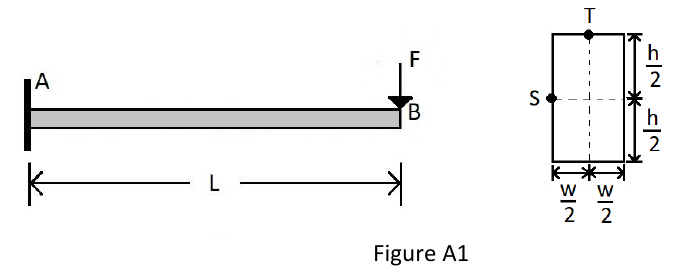
Consider the cantilevered beam of length in Figure A1, subject to the transverse load . The beam has rectangular cross section of width and height , and the second area moment past the neutral axis of this cross section is . The beam's material has Young's modulus . The line of action of is parallel to the side of height , as indicated in Figure A1.
Formulas you may need
- Pure bending: , (on the formula sheet)
- Rectangle: , , (on the formula sheet)
- Transverse shear stress: , for a rectangle (learn this; on the 2025 sheet but not the 2026 one)
- Principal stresses: , (learn this)
- Euler buckling: with for a cantilever (on the formula sheet; is also given in the question)
- Safety factor and strength limit: , (learn this)
- (a)[7]2:2Considering the beam cross section at the fixed support A and making use of the plane stress theory, show that the maximum normal stress at point S of the beam surface is given by Equation 1 and state if this normal stress is parallel to the beam axis, justifying your answer.
- (b)[9]Assuming m, kN, mm, determine the height of the beam cross section if the maximum allowable normal stress of the material of 120 MPa is not to be exceeded in any part of the beam.
- (c)[7]2:2The beam designed in part (b) is now subject only to a centric compressive axial load, and GPa. Assuming maximum allowable normal stress of 120 MPa and buckling safety factor of 2, determine the maximum centric compressible axial load applicable to the beam fulfilling the strength and buckling stability requirements. Please note that the equivalent length of a cantilevered beam subject to axial load is twice its geometric length.