ENGR216 Summer 2018 Q A1[VALID] official answers
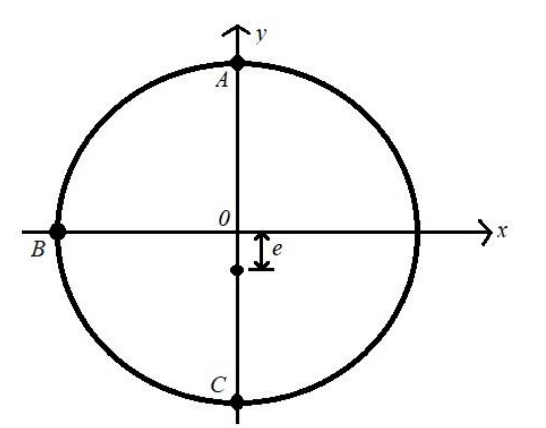
A pin-ended metal post of length with circular cross section of radius supports a compressive axial load applied at distance from the section centre, as indicated in Figure A1. Use a Young's modulus of .
Formulas you may need
- Euler critical load, pin-ended: with (on the formula sheet; also printed in this paper's appendix)
- Circle: , , (on the formula sheet)
- Eccentric axial loading: , , , compresses fibres at (on the formula sheet; also printed in this paper's appendix)
- Safety factor: ; allowable stress (learn this)
- Uniaxial stress: maximum shear on planes at (learn this)
- Principal axes , max shear axes (learn this; printed in this paper's appendix but not on the 2026 sheet)
- (a)[3]2:2Assuming , an allowable normal stress of and a buckling safety factor of 2.5, determine the minimum radius of the cross section required for yield- and buckling-free operation.
- (b)[4]2:2Assuming and using the value of obtained at (a): determine the distance (with sign) of the neutral axis from the -axis. Briefly comment on this result with regard to the sign of the normal stress in the section, and sketch the diagram of the resulting normal stress along the axis of the section clearly indicating the neutral axis;
- (c)[6]2:2at positions A, B and C determine the normal stress acting on the post cross section and the maximum shear stress on the post surface.
- (d)[7]Consider three small squared surface elements with two sides parallel to the axis of the post (axis ) and centered at points A, B and C. At these three points, determine the orientation of the principal axes and the maximum shear axes with respect to the axis .
- (e)[5]FirstBriefly comment on how the stress variations due to the axial load eccentricity may impact on the strength and the buckling stability of the post using the value of determined at (a).