ENGR216 Summer 2023 Statics Q A1[VALID]
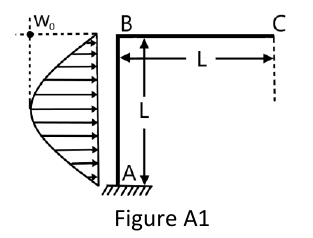
Figure A1 shows a cantilevered structure of negligible mass. The vertical member AB of the structure is loaded by a parabolic distributed normal load , which is given by:
where is the coordinate along the mean line of the vertical member AB (origin at A), which has length .
Formulas you may need
- Distributed load resultant: , acting at (on the formula sheet)
- Load-shear-moment relations: , and their integral forms (on the formula sheet)
- Equilibrium of a rigid body: , , (learn this)
- Elastic curve: , slope , integrate with the support conditions (learn this; on the 2025 sheet but not the 2026 one)
- Small rotation of a straight member: transverse displacement (learn this)
- Mean normal stress: (learn this)
- Pure bending: , (on the formula sheet)
- Square section: (from ) (on the formula sheet)
- (a)[5]2:2Draw the free-body-diagram of the entire structure, indicating only nonzero reactions and applied loads.
- (b)[5]2:2Calculate the reactions acting on the considered structure (3 marks), and draw the elastic curve of the member BC as accurately as possible, accounting for the suppressed degrees of freedom (2 marks).
- (c)[10]Knowing that the bending moment along the vertical member AB is demonstrate that the magnitude of the vertical displacement of point C is: where is the flexural rigidity (5 marks). State what is the mean normal stress in the cross sections of members AB and BC, and explain why (5 marks).
- (d)[5]2:2Member AB has length m and features a square cross section, and kNm. Calculate the minimum length of the edge of the square cross section such that the normal stress at the midpoint of member AB does not exceed 130 MPa.