ENGR216 (old spec) Statics session 16 worked example 2 (Problem, slides 13-16) official answers
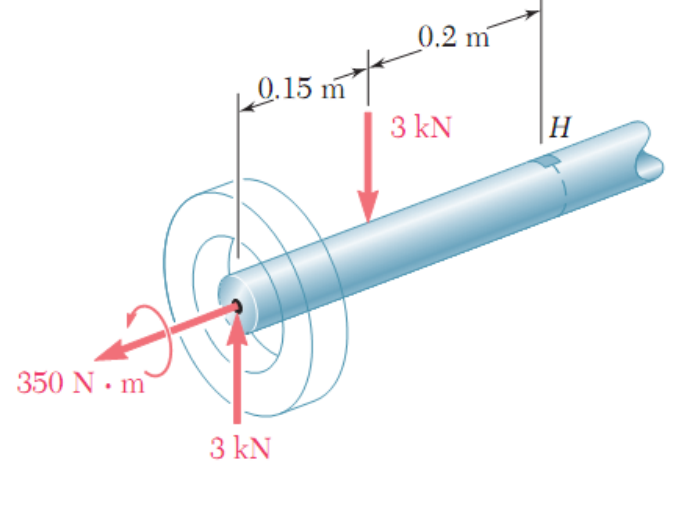
The solid axle of an automobile, radius mm, is acted upon by the forces and torque shown: an upward 3 kN reaction at the wheel, a downward 3 kN load from the car body applied 0.15 m inboard of the wheel, and a torque of 350 N m. Point H is on the top of the axle, 0.2 m further inboard than the body load, in the central part of the (symmetric) axle where there is no shear force. Use axes with along the axle from the wheel towards H and normal to in the surface plane at H; with these axes the torque produces a negative shear stress at H.
Determine:
Formulas you may need
- Bending stress , solid circle (on the formula sheet)
- Torsion , (learn this)
- Principal stresses , , (learn this)
- (a)the principal axes and principal stresses at point H on top of the axle;
- (b)the maximum shear stress at the same point.