ENGR5004 Statics Tutorial Sheet 3, Problem 2 official answers
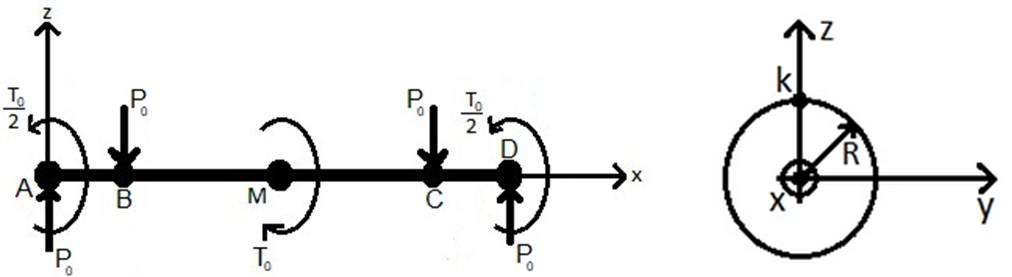
Consider the free-body diagram of the axle AD depicted in the left plot below, with dimensions AB = CD = 500 mm and BM = MC = 1000 mm. The axle cross section, depicted in the right plot below, has radius mm. The axle is subject to an engine torque kNm applied at position M, two resistive torques applied at A and D, two vertical loads kN applied at B and C, and two vertical reactions applied at A and D.
Formulas you may need
- Load-shear-moment relations and sign convention: , (on the formula sheet)
- Bending stress (formula sheet: with the vertical coordinate), solid circle (on the formula sheet)
- Torsion: , (learn this)
- Principal stresses and maximum in-plane shear: , (learn this)
- (a)Determine the expression of the bending moment , shearing load and torsional load along the entire axle.
- (b)Sketch , and along the entire axle.
- (c)State at which portions ( interval) of the axle, one has a plane stress state on the axle surface and justify your answer.
- (d)Determine the magnitude of the maximum normal stress at point K indicated in the right plot below acting on the axle surface at any axial position between B and M, and state if this stress is tensile or compressive.
- (e)Determine the magnitude of the maximum shear stress at the point K indicated in the right plot below acting on the axle surface at any axial position between B and M.