ENGR5004 Statics Tutorial Sheet 4, Problem 3
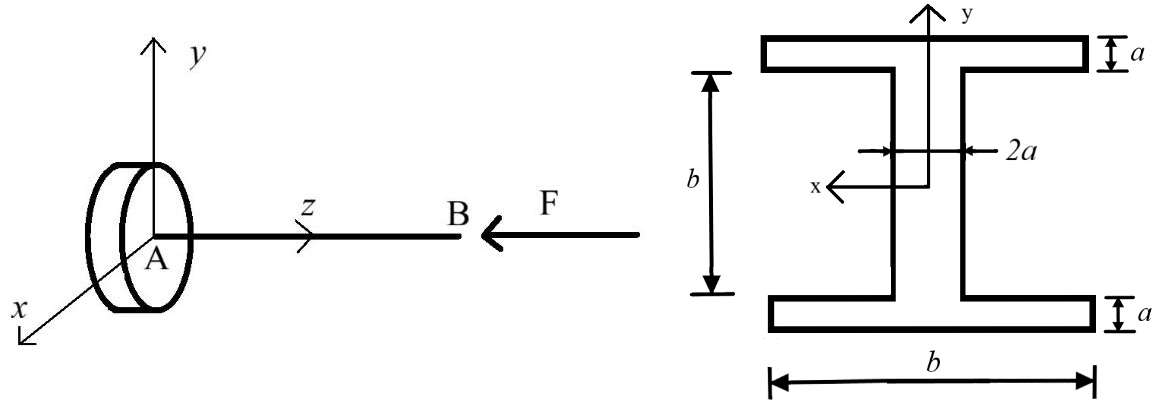
The bottom left figure below shows a rod of negligible mass of length subjected to a compressive axial load . The rod is constrained by a fixed support at end A. The rod's cross section is depicted in the bottom right figure below, in which .
Formulas you may need
- Euler critical load ; effective lengths fixed-free , fixed-fixed (on the formula sheet)
- Rectangle , (composite section by addition/subtraction) (on the formula sheet)
- Parallel-axis theorem (alternative route for ) (learn this)
- Axial stress (learn this)
- (a)Assuming that the compressive load exceeds by a small amount Euler's critical load, determine and clearly state if the rod will buckle in the or plane.
- (b)Draw as accurately as possible the shape of the buckled rod, labelling the two Cartesian axes defining the plane in which the rod buckled, and fulfilling the applied constraints in the drawn schematic.
- (c)Using kN, allowable normal stress of 90 MPa, Young's modulus of 180 GPa, m and a safety factor of 2 for the buckling critical load, calculate the value of required for the rod not to buckle and not to yield.
- (d)Assuming that the rod designed in question c) is constrained by a fixed support at both end A and end B, and using a safety factor of 2 in the buckling analysis, determine the maximum axial load the rod can bear without buckling and yielding.