ENGR5004 Statics session 2 problem set for week 4 (slide 14, with answers), worked in old-spec Statics session 7 Problem 2 (slides 9-13) official answers
Rod CE and rod DF are attached to the rigid horizontal bar ABCD, which is pinned at B. Distances along the bar: mm, mm, mm. Both rods hang vertically down from the bar to fixed supports at E and F: rod CE has length 450 mm and diameter 10 mm; rod DF has length 562 mm and diameter 15 mm. Both rods are steel with GPa. A vertical downward load of 100 kN is applied at end A of the bar.
Determine:
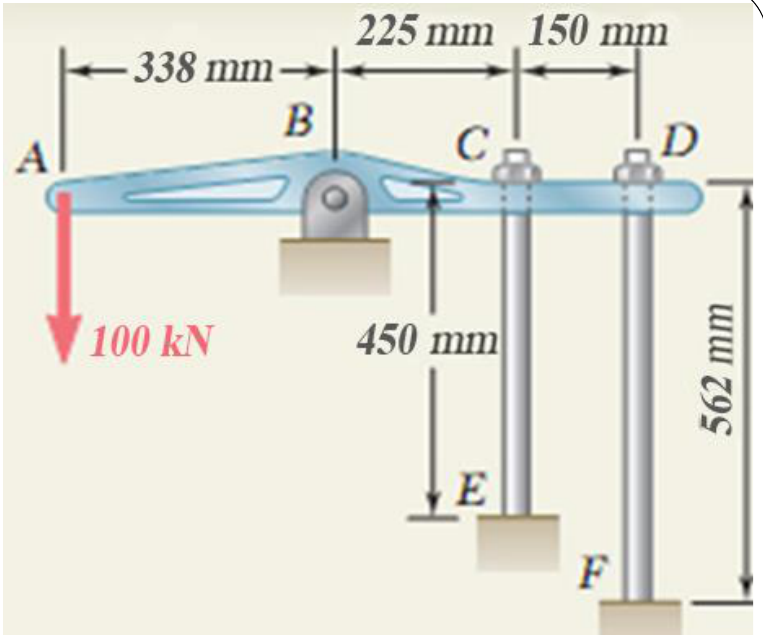
Formulas you may need
- Equilibrium of a rigid body: , (learn this)
- Axial deformation , circle (learn this; circle area on the formula sheet)
- Rigid bar rotating about B: displacements proportional to distance from B (similar triangles) (learn this)
- Bending moment by the method of sections; (on the formula sheet)
- (a)the internal force in each rod;
- (b)the vertical displacements of bar ends A and D;
- (c)the maximum absolute value of the bending moment in the bar, and where it occurs.