ENGR5004 Statics Tutorial Sheet 2, Problem 3 official answers
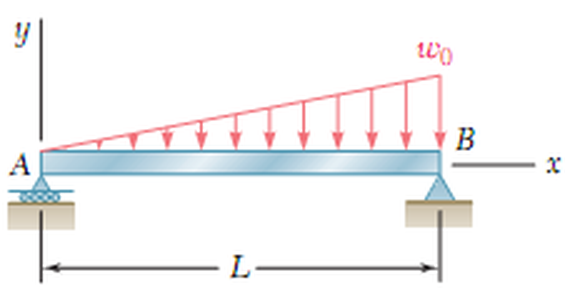
Consider the loaded beam shown below, subject to a triangular distributed load, constrained by a roller at its left end, and pinned at its right end.
NOTE: the beam of problem 3 is that for which we computed shearing load and bending load in problem 4 of Tutorial 1. Please start the solution of problem 3 (tutorial 2) by using the expression of determined in problem 4 of Tutorial 1.
Formulas you may need
- Load-shear-moment relations: , (on the formula sheet)
- Elastic curve: , maximum deflection where (learn this; on the 2025 sheet but not the 2026 one)
- (a)Calculate the position along the beam axis where the maximum deflection of the beam occurs, expressing it as a fraction of the beam length ;
- (b)calculate the absolute value of the maximum deflection of the beam , expressing it as a function of the flexural rigidity , the beam length , and the distributed load at beam end B (note that is Young modulus and is the second area moment past the cross section neutral axis), and state if the deflection is upwards or downwards.
- (c)calculate the numerical value of the maximum deflection , assuming , kN/m, m, and GPa.